Cracks in a House: When Should You Call a Structural Engineer?
Learn what different crack patterns may indicate, why width alone cannot identify the cause and when a structural inspection is sensible.
Most cracks are not evidence of serious structural movement. A structural inspection is sensible when cracking is new or worsening, repeatedly returns after repair, appears with distortion elsewhere, or has been highlighted by a surveyor or lender.
Engineering content reviewed 21 September 2026.
A Specific Structural Inspection provides a focused assessment and written report for one defined concern.
Get a fixed-price crack inspection quoteWhy do cracks appear in houses?
Cracks can develop because of plaster shrinkage, changes in temperature or moisture, normal settlement, movement between different materials, alterations, drainage defects or movement affecting the foundations. Their appearance alone does not always establish the cause.
A structural engineer considers the crack as part of the building rather than as an isolated mark. Its position, direction, width, age and rate of change are considered alongside the property's construction, nearby openings, floor levels, previous repairs and relevant external conditions.
Which crack patterns deserve closer attention?
No single crack pattern proves subsidence, but certain features justify further investigation, particularly where more than one is present.
- Diagonal or stepped cracking from doors, windows or building corners
- Cracking visible in corresponding positions inside and outside
- Separation where an extension, conservatory or bay joins the original house
- Horizontal cracking, bowing or bulging in a wall
- Cracks that continue to widen or return after repair
- Cracking accompanied by sticking doors, distorted openings or changing floor levels
- A concern specifically referred by a surveyor, lender or insurer
Possible immediate danger: Loose masonry, sudden substantial movement or visible instability may require urgent safety advice. Keep clear of an element that appears unstable and do not disturb it.
Do cracks around windows, doors and extensions mean subsidence?
Not necessarily. Openings interrupt the wall and concentrate stresses, so cracking can result from lintel movement, changes in materials, thermal movement or local detailing as well as foundation movement. Cracks at an extension may reflect different foundation depths or construction periods rather than movement affecting the whole property.
The pattern must be assessed with the surrounding structure. A crack at one junction with no related distortion may have a different significance from stepped external cracking accompanied by a sticking window and a sloping floor.
How much does crack width tell you?
Width is useful evidence, but it is not a diagnosis or a stand-alone safety test. Fine cracks are often cosmetic, yet the position and pattern of a narrow crack may still justify investigation. Wider cracks generally deserve closer attention, especially when accompanied by distortion or continuing change.
Published damage classifications can help describe cracking consistently. They do not replace an assessment of the building, the likely cause and whether the movement appears historic, seasonal or potentially active.
Historic or active movement: how can you tell?
An inspection may identify evidence that movement is longstanding, such as weathered cracks or old repairs that have remained intact. Fresh edges, progressive distortion or cracks reopening after repair may suggest more recent movement. A single visit cannot always establish whether movement is continuing.
Where the available evidence is inconclusive, dated photographs, crack monitoring, drainage checks or further investigation may be recommended. The report should explain the uncertainty rather than give a definite conclusion that the evidence cannot support.
Should I monitor the crack or arrange an inspection?
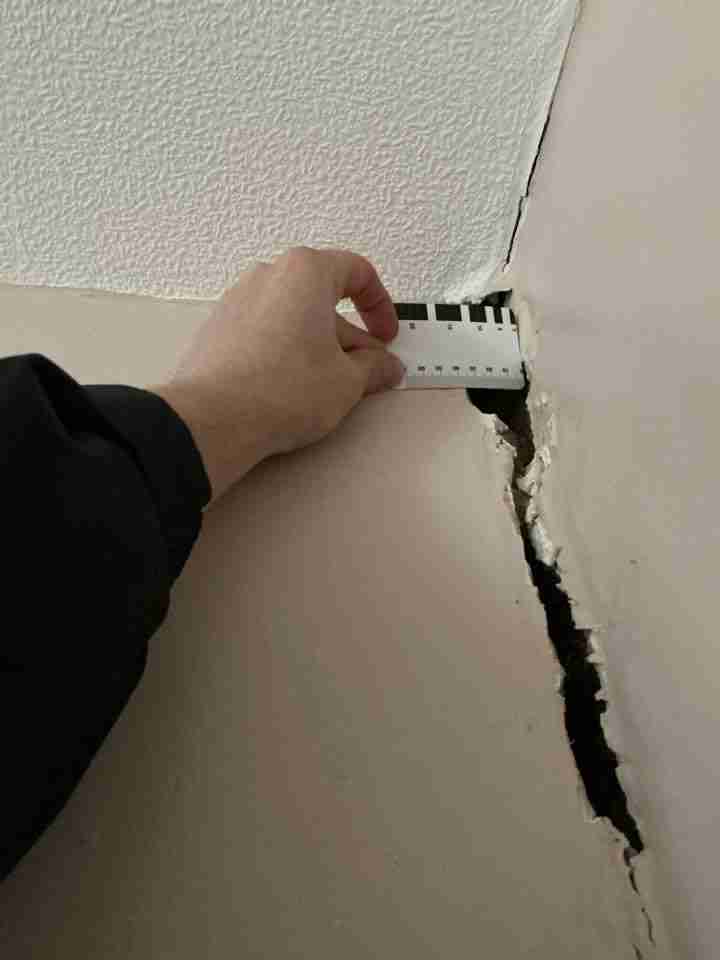
Monitoring may be proportionate where a crack is fine, appears stable, has no related distortion and has not been raised as a requirement in a property transaction. Take dated photographs with a ruler or other scale and avoid hiding the crack before its behaviour is understood.
Arrange structural advice where a crack is new or worsening, returns after repair, appears in corresponding positions inside and outside, is accompanied by sticking openings or distortion, or has been referred by a surveyor, lender or insurer. Photographs help with triage, but they cannot reliably establish the cause on their own.
What should I do after a survey identifies cracking?
Send the exact survey wording and photographs if available. One defined area of cracking will usually suit a Specific Structural Inspection. Several separate structural concerns, or a request to consider the main structural elements more broadly, may require a General Structural Inspection.
During the agreed inspection, the engineer records the crack pattern, considers related parts of the property and looks for evidence that may explain the movement. The inspection is normally visual and non-intrusive unless another scope has been agreed.
Need professional help with this?
Specific Structural Inspection — fixed price from £480, including the agreed site inspection and written report.
Get a fixed-price crack inspection quoteFrequently Asked Questions
Get expert advice
- Written by a Chartered Engineer (CEng MICE) with over 15 years’ structural engineering experience.
- Reports usually delivered in 3–7 working days
- Professional indemnity and public liability insurance
- 173+ five-star reviews on Google & Trustindex
Get Your Instant Quote
Enter your postcode to check coverage and see pricing